

Everyone Knows Everyone (And I Mean Everyone)
When I sat down to write this blog, my mind was spiraling with how to showcase what I’ve learned. There has been so much packed into this past year that it was hard to know where to even begin. One thing kept coming to mind first – everyone really knows everyone, and I mean everyone. When an “outsider” thinks about publishing, they might picture a sprawling landscape of companies and organizations, all operating independently in their own corners. It came to my surprise that scholarly publishing isn't like that at all. You run into the same people at conferences, see the same names in email threads, and realize quickly that there's absolutely no hiding here. It's the kind of industry where you can't slip through the cracks or start fresh somewhere else because odds are that your new colleagues already know your former colleagues, probably grabbed drinks with them at the last conference, and might even be related to them. Okay, maybe not related, but you get the idea.That interconnectedness shapes how business gets done in ways I didn't anticipate. Relationships matter more than in other industries I've worked in. Decisions aren't just transactional - they're built on trust, shared history, and long-term partnerships. Publishers and societies often work with the same platform providers for years, even decades, because switching isn't just a matter of comparing features and pricing, it's about whether they can rely on a partner who understands the nuances of their mission and the specific challenges they face. That sense of community is refreshing, honestly. In an industry this small, burning bridges isn't just bad practice - it's basically professional self-sabotage. So, people tend to be collegial, helpful, and willing to share knowledge in ways that might seem strange if you're coming from a more cutthroat environment.
Scholarly Publishing Is Global (Who Knew?)
Another thing that caught me off guard was realizing how genuinely global this industry is. Team members are constantly jetting off to conferences or client meetings in cities and countries I'd struggle to find on a map without Google's help. At first, I assumed scholarly publishing would be relatively regional, American publishers working with American institutions, European publishers sticking to Europe, that sort of thing. Turns out I was completely wrong. Research doesn't care about borders, so the infrastructure supporting it can't either. A journal published by a society based in the US might have editors in Australia, authors submitting from labs across Asia and Europe, and readers accessing content from basically anywhere with an internet connection. The platforms and systems managing all of this have to account for different languages, time zones, regulatory requirements, and user expectations across regions. It's another layer of complexity I hadn't even thought about when I started, but it also makes the work more interesting. From a marketing perspective, you're not just thinking about one market or one audience. You're communicating value to a global community of publishers and researchers, all with different needs and contexts. Plus, the time zone math for scheduling meetings and sending content keeps you sharp.The Acronym Avalanche
The learning curve was steeper than I expected, and not just because of the acronyms, though those nearly did me in at first. There are publishing acronyms, company acronyms, product acronyms, technology acronyms - my first few weeks involved a lot of quiet Googling and nodding along in meetings while frantically taking notes I'd decode later. Even still I sometimes feel like I am trying to translate a set of hieroglyphics that will lead me to a secret room to steal the treasure (think Indiana Jones, but without the big boulder). I'd head into a meeting and leave thinking, “um what was that about and why were we speaking a different language?” I mean, Silverchair even has a candle scent specifically titled, "Acronym Overload." Slowly but surely, I have come to understand this new language and feel confident following along with conversations that I would have previously been lost in. 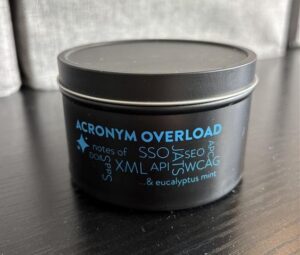
But beyond the terminology, I also had to figure out how this industry actually functions. Who are the clients? That question alone took weeks to fully understand - scholarly publishers aren't a uniform group. There are commercial publishers, university presses, and member societies, and they all approach content, technology, and business strategies differently. Each type of organization has different needs, different pain points, and different decision-making processes. Understanding those distinctions became essential to understanding how to market what Silverchair offers and why it matters to each type of client.
Then there's the question of how you actually reach these clients and build relationships with them. In some industries, sales and marketing follow predictable patterns - you identify prospects, you pitch, you close deals. I’ve come to learn that scholarly publishing doesn't work that way. Since the industry is so relationship-driven and platform decisions are significant long-term commitments, the approach has to be more nuanced. It involves understanding current challenges in the industry, being present in the right conversations, and demonstrating through our messaging and positioning that we're not just selling software but offering partnership and expertise.
Why It All Matters
Before joining Silverchair, I understood scholarly publishing in abstract terms - journals and articles existed, research got published, people read it. I didn't fully grasp the role scholarly publishers play in making sure that groundbreaking research actually reaches the people who need it. Major medical breakthroughs, studies that influences policy decisions, research that shifts how we understand the world, it moves through this industry.Scholarly publishers aren't just publishing content, they're managing peer review to ensure research meets rigorous standards. They're building discoverability tools so researchers can find relevant studies amid an overwhelming volume of published work, because apparently "just Google it" doesn't cut it when you're trying to advance scientific knowledge. They're preserving content so that decades from now, future scientists can build on today's discoveries. The infrastructure that Silverchair builds and that our clients rely on isn't just nice to have, it's essential to how knowledge moves through society. Understanding that added a different dimension to the work I do in marketing. It's not just about positioning a product or crafting messaging. It's about communicating the value of solutions that enable our clients to fulfill their missions more effectively.