


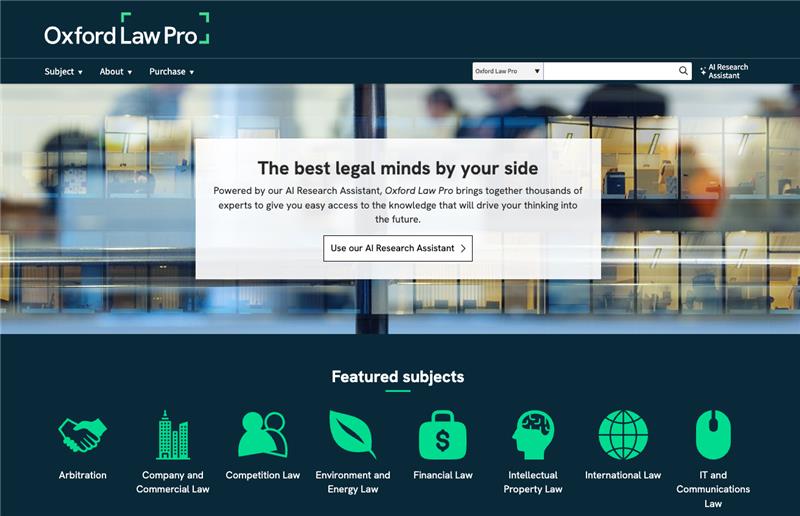
Oxford University Press (OUP), the world’s leading university press, has a long history of leveraging technology to further their mission of serving scholars, teachers and researchers. They partnered with Silverchair to transform legal research for professional practitioners while maintaining the trust and accuracy standards central to OUP’s 500-year reputation. The result was Oxford Law Pro—a specialized legal research product featuring a conversational AI Research Assistant that fundamentally changes how legal professionals navigate professional and scholarly content.
The challenge
Legal professionals face a distinct research challenge. For lawyers and legal researchers, accuracy is paramount—the risk of hallucinations, bias, or unreliable information through low-quality AI tools poses unacceptable professional and ethical risks. Traditional keyword search often requires specialized legal vocabulary and delivers overwhelming result sets demanding extensive filtering. What these professionals need are tools that work alongside their expert judgment rather than attempting to replace it, identifying relevant content quickly while maintaining complete transparency about sources and reasoning.
A Collaborative Approach to Responsible AI
The development of Oxford Law Pro’s AI Research Assistant exemplifies the partnership approach that defines successful innovation in scholarly publishing. Building production-ready AI requires moving beyond prototypes to create systems that integrate seamlessly with existing workflows while meeting rigorous quality standards. This approach is central to Silverchair’s AI Lab and client collaborations.
OUP brought deep editorial and product expertise, a collection of more than 9,000 journal articles and over 600 award-winning peer-reviewed books spanning key practice areas, and an understanding of how legal professionals actually conduct research. Silverchair contributed platform infrastructure, AI implementation capabilities, and experience translating publisher requirements into technical architectures that scale. Together, we built a system specifically tuned for legal content, employing retrieval-augmented generation (RAG) frameworks that ensure responses are grounded exclusively in OUP’s authoritative materials.
The collaborative development established patterns supporting ongoing refinement based on user feedback, technological advances, and evolving legal research needs—recognizing that AI implementation is an iterative journey rather than a one-time deployment.
The solution
What distinguishes Oxford Law Pro from generic AI search tools is our comprehensive approach to trust and transparency. The RAG architecture understands legal terminology across jurisdictions, distinguishes settled law from emerging debate, recognizes similar concepts across different terminology, and synthesizes information while maintaining proper attribution.
Crucially, the system operates within clear boundaries. It matches user queries against the most relevant legal analysis before synthesizing contextual responses, returning only trusted, peer-reviewed OUP sources . The interface clearly indicates relevancy scores for each source, displays direct quotes with quotation marks to distinguish synthesized content from original text, provides extract pop-outs showing relevant passages from source materials, and explicitly states when it doesn’t have sufficient information to answer a query.
Security and confidentiality were foundational considerations. All interactions are secure, with both OUP and Silverchair maintaining ISO 27001 certification. User queries are processed and stored in ways that do not compromise confidentiality, with only anonymized data collected to monitor performance trends.
Impact
Since launching, Oxford Law Pro’s AI Research Assistant has demonstrated meaningful efficiency gains while maintaining the trust standards legal professionals require. The AI Research Assistant generates concise 300-word responses grounded in five highly relevant citations, greatly reducing the amount of time spent searching for the content they need.
The system supports legal professionals with a clickthrough rate that is higher than traditional search, signaling high-quality answers that efficiently connect users to relevant legal content. These engagement patterns reflect a tool that matches how legal professionals actually work—approaching research as evolving investigations requiring contextual understanding rather than simple keyword retrieval.
Oxford Law Pro demonstrates that AI-enhanced discovery can meet the elevated trust and accuracy standards required in professional fields while delivering meaningful efficiency gains. This approach—transparent, constrained to authoritative sources, and designed to complement expert judgment—provides a model for other domains where similar accuracy imperatives exist.
Learn more about Oxford Law Pro and the AI Research Assistant at https://academic.oup.com/info-oxford-law-pro.