

Bringing together case studies, innovators in adjacent industries, and in-depth discussions on the hot topics, Platform Strategies offers powerful insights for publishing leaders. The event returns to Washington, DC on September 23rd to tackle the technology challenges facing the scholarly publishing industry. This year's agenda centers around "Signal and Noise” — exploring how our industry is tackling overloaded submission queues, distinguishing quality from misinformation and slop, and separating hype from promise in all things AI.
Review the agenda and hear from last year's attendees below, then secure your spot here before the September 1st deadline.
Agenda
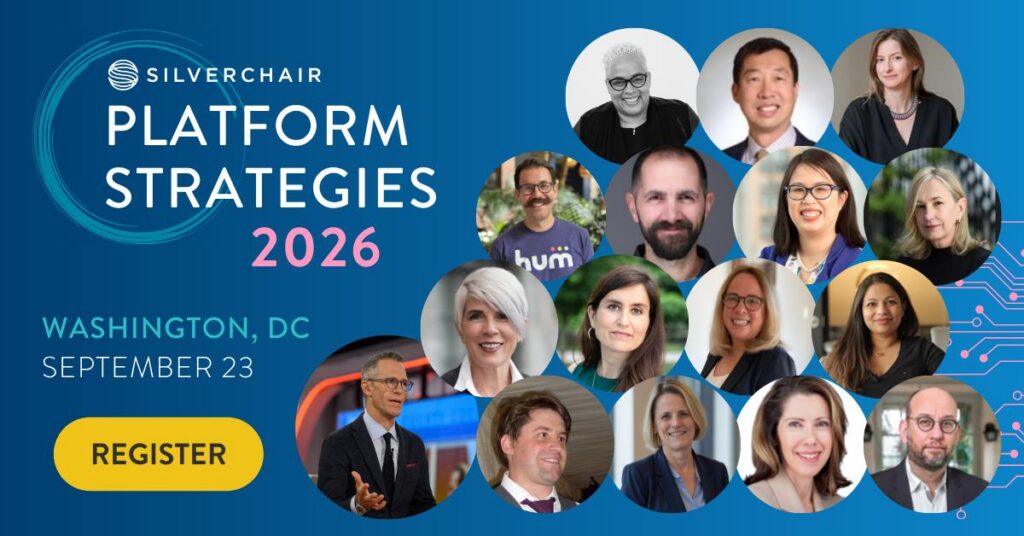
Confirmed speakers are listed below—check back for updates as the event approaches.- Opening Keynote: Wendy Queen, Chief Transformation Officer, Johns Hopkins University Press: As we start the day, let's take stock of where we are — charting the distance between last year's conversations and now. Drawing on collective learnings from across the scholarly publishing community, we'll look at how AI has reshaped researcher workflows over the past year, moving beyond early-stage questions about potential to honest reflection on real-world impact.
- Beyond integrity: why quality is the next frontier for the research record: A paper can pass every integrity check and still be bad science. That's the problem. The research integrity field has spent two decades building tools to catch bad actors — flagging suspicious co-authorships, non-institutional emails, citation rings, AI-generated text. Useful signals, but superficial ones when it comes to measuring actual quality. Now add a 30% surge in submissions, driven by AI-assisted research, thin-slicing, hyperprolific authors, and outright slop. The integrity toolkit was never built for this, and the stakes extend well beyond peer review process. As LLMs increasingly serve as the first — and sometimes only — point of contact between a researcher and the published literature, low-quality work that clears the integrity bar doesn't just pollute the record; it gets ingested, synthesized, and surfaced as fact. What publishers decide to publish now shapes what AI systems tell the next generation of researchers. This panel makes the case that it's time to move past pattern-matching on proxies and start asking the harder question: Is this work any good?
- Dustin Smith, CEO & Co-Founder, Hum (moderator)
- Dawn Melley, Senior Director, Publishing Operations, IEEE
- Miriam Maus, Chief Publishing Officer, IOP Publishing
- Jonathan Woahn, Co-Founder, Cashmere
- Table Topics: Peer (Review) Pressure: This interactive session explores the pressures that peer review is under from every direction — rising submission volumes, shifting researcher expectations, AI tools that are reshaping how authors write and how reviewers evaluate, and growing concern about research integrity across the ecosystem. Understanding what's actually happening at the reviewer and author level, at scale and over time, is essential for making platform and process decisions that hold up. This session will present longitudinal data on the state of peer review, then engage in small-group discussions around a real-world scenario to develop concrete strategies and recommendations.
- Truth has a platform problem: technology's role in the misinformation era: Scientific misinformation doesn't win by accident. It wins because it's well-packaged, emotionally resonant, and algorithmically rewarded — and because the systems meant to surface verified research weren't built with that adversarial dynamic in mind. At the same time, AI-powered discovery is reshaping the information environment in ways that make the stakes even higher: when a language model mediates the relationship between a researcher and the published literature, the decisions publishers and platform providers make about architecture, metadata, and content surfacing have consequences that extend far beyond a single search session. Drawing on recent experiments in science communication, the panel will examine the intersection of misinformation and technology choices and consider how new formats — such as structured dialogue around conflicting findings or more transparent engagement during research integrity challenges — can strengthen public understanding and trust. What does it mean for platforms and tools to be AI-ready not just in a technical sense, but in a trust sense: building systems that reward accuracy, position content for responsible discovery in LLM-driven environments, and bring the rigor of scholarly publishing into the new information landscape.
- Ryan Ross, Silverchair (moderator)
- David Sampson, Chief Publishing Officer, NEJM
- Meagan Phelan, Communications Director, Science Magazine
- Suze Kundu, Defend Research
- What's your strategy if there is no platform, REDUX: Two years ago, we asked the uncomfortable question: what happens if platforms as we know them disappear? Today, these conversations have become very real. AI systems now synthesize answers from across the published literature without sending users to the publisher platform. Discovery increasingly happens in environments that publishers don't own, can't instrument, and have limited ability to influence. The disintermediated future that panel imagined is, in meaningful ways, already arriving. This session revisits that original conversation with two years of hard evidence and a sharper set of questions. What has actually changed since then, and what do publishers wish they'd done differently? If the platform is no longer the default point of contact between researcher and research, what is its job — and how do you build an audience that chooses to come back to it? Panelists will examine how publisher platforms are evolving and what feature and partnership decisions matter most when the intermediary is increasingly AI rather than a search engine.
- Will Schweitzer, CEO, Silverchair (moderator)
- Alison Mudditt, Chief Executive Officer, PLOS
- Andy McGregor, VP of Product Innovation, Sage
- Ann Michael, Chief Transformation Officer, AIPP
- David Crotty, Executive Director, Cold Spring Harbor Press
- Hello from the other side: what other industries can teach publishing: Scholarly publishing has no shortage of insiders. What it has less of is the outside view — the perspective of people who have watched adjacent industries wrestle with the same forces and come out the other side with lessons that don't yet have a scholarly publishing translation. This session brings leaders new to or from outside the industry to share experience from sectors that have already lived through versions of what scholarly publishing is now confronting, offering the kind of pattern recognition that only becomes visible when you take time to stop and zoom out.
- David Nygren, Silverchair (moderator)
- Penny Ladkin-Brand, CEO, Taylor & Francis
- Kelli Palmer, Former Global Vice President of Employee Experience, TELUS Digital
- Ha-Hoa Hamano, Principal Product Manager, U.S. Department of Education
- Closing Keynote: Jacob Ward has served as technology correspondent for NBC News and Al Jazeera, host of PBS's Hacking Your Mind, and Editor-in-Chief of Popular Science, where he led coverage of innovation and the future of technology. His work focuses on the intersection of AI, psychology, and human agency, asking not just how we use technology, but how it changes us. He challenges audiences to think beyond efficiency and consider what human skills must be protected in an AI-driven world, from critical thinking and creativity to collaboration and emotional intelligence.
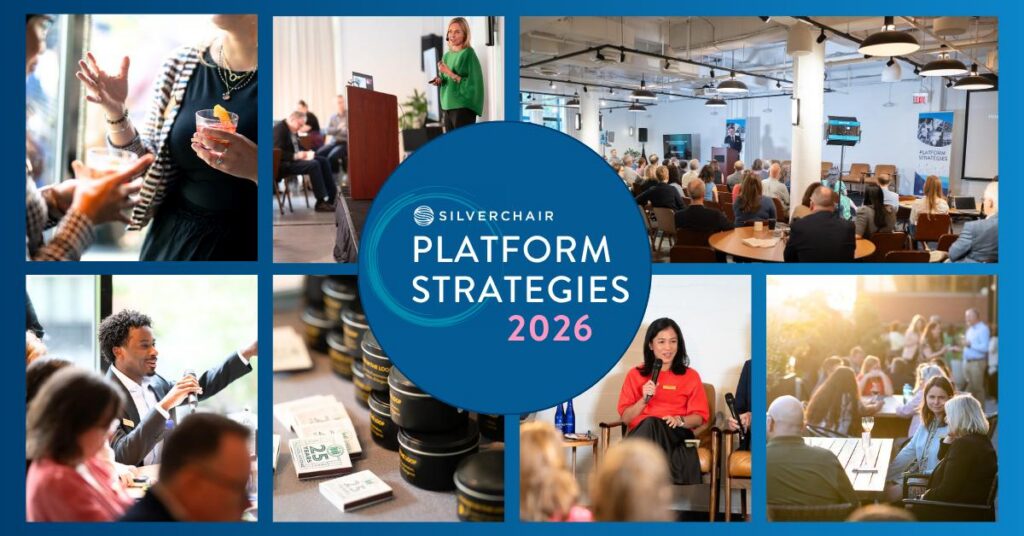
Here's what last year's attendees had to say:
“The sense of belonging, openness, and shared purpose makes this space more than just a gathering. It's the heartbeat of our collaboration, the reason people return not just for content, but for connection. Innovation can evolve, formats can shift, but the spirit of community remains constant.” —Warren Adams, ASTMRegister here to secure your spot before September 1!"I really enjoy this event as I think too often the topics you touch upon are glossed over at other events."—Barry Bealer, Impelsys
"There's a reason Silverchair's Platform Strategies makes our must-attend list every year! It's where some of the most important conversations happen—both on stage and around the dinner table afterward." —Hum (event sponsor)
“Silverchair's Platform Strategies event is becoming the go-to scholarly publishing event of the fall schedule. It's great that it's a 1-day event, making it easy to fit a busy schedule. The program packs a lot of thought-provoking topics and conversations but also allows for ample networking time.” —Marianne Calilhanna, DCL (event sponsor)
“The event itself is perfection. Platform Strategies is my favorite day of the Scholarly Publishing Year! No detail is missed in the planning and execution of this event. From the venue to the food to the swag to the best speakers in scholarly publishing, Silverchair thinks of everything. Most importantly, though, they make every single one of us feel like the most important person in the room." —Jennifer Regala, ACOG
Platform Strategies 2026 is generously sponsored by Hum, DCL, Access Innovations, Digital Science, Impelsys, and ATIV Software.