Silverchair makes extensive use of AI. This year's employee survey put daily AI tool usage at roughly 88% of the company. We have deployed Claude across our organization, our technologists work with Claude Code, and our AI and People Operations teams built a skills program to get people there. Our Product team AI Lab puts prototypes in front of publisher development partners early rather than late. These tools enable our strategy, and none of what follows is a call to slow our adoption or use of AI tools.
This is a note about a second-order effect of our AI use, and about a standard our clients should hold us to.
Volume moves cost from the writer to the reader
Tools like ChatGPT, Claude, or Gemni, drafting is cheap, and cheap drafting produces immense volume, which the internet has taken to calling AI slop. I have read one too many dense and repetitive memos, chewed on slides assembled faster than they were argued, and worked through chat messages that take four paragraphs to make a one-sentence point. This is a universal knowledge worker problem, and the research is not flattering. BetterUp Labs and Stanford's Social Media Lab found that 40% of full-time employees had received AI-generated work in the prior month that looked finished but lacked the substance to move the task forward, at a cost of nearly two hours of rework for each instance.Our community is living its own and often hellish version of this. Submission queues across the industry are up 30% and climbing, driven partly by AI-assisted research and partly by outright slop, and every one of those manuscripts lands on an editor or editorial assistant who has to read it. Publishers and peer reviewers are absorbing the cost of other people's cheap drafting. The least Silverchair can do is not slop up a bid response, an implementation plan, renewal conversation, or substantive email.
How we write
Here is the standard we are trying to hold internally, offered in case any of it is useful to you.Edit assiduously. You own every word you send, whether or not you typed it. Drafting is fast; editing is where you add value, and it is not optional. If you would not defend a sentence word by word in a room with me or a client, it does not go out.
Length is usually an inverse proxy for thinking. David Ogilvy capped his memos at two pages, and the rest of his writing advice holds up. When a document needs ten pages, the argument is not finished, and adding pages will not save it. Lead with the decision you need or the thing that changed, in the first three lines. Context belongs after that, and most of it belongs in a link.
Write in your own voice. This is the one that matters most. I know how our leaders argue, frame risks, or build a case. When that texture disappears, I discount the document, not because I’m stubborn but because generic prose carries no signal about who thought about it or how hard. Your voice is a credibility asset, and it is the one thing these tools cannot supply for you. I want to hear from the person, not the model. My colleagues are often smarter and funnier than Claude.
Match the format to the question. A quick question deserves a quick answer. Length is not respect, and it usually reads as the opposite. These tools have a default register, earnest and hedged and corporate. They are at their worst in preparing slides, where it produces confident-sounding bullets or illogical subheads that nobody would say out loud. Where AI tools excel is upstream: research, pressure-testing an argument, surfacing the frameworks and questions worth discussing. Don’t be an antiseptic ass, treat AI as an advisor rather than a ghostwriter. Do the thinking with it and then the writing yourself.
The same discipline governs our software development practices
This is not only an internal writing standard, and you can check our work against it.When client conversations in the ScholarOne AI Playground told us publishers would rather spend their AI exploration time on discovery and search than on automated content generation, we left AI-Generated Summaries in the lab. When we launched the Editor AI Console for ScholarOne Manuscripts in July, we made the prompts visible and editable to editors rather than shipping a black box, and we built it as focused modules rather than a single assessment engine. Both these decisions cost us velocity, and both were the right call, for the same reason the writing standard exists: the output of these tools is only as good as the judgment applied to it, and judgment has to belong to a named human being.
Our colleague Lily Garcia Walton wrote about this from the other direction in April, and noted that not a single word of her piece was generated by AI. That is the right instinct, and it is worth stating plainly that a company can be enthusiastic about this technology and unsentimental about its prose at the same time.
What we ask of ourselves
Before any communication we’ve drafted with AI leaves our hands, I’ve asked my colleagues to: read it aloud, cut it by a third, confirm every claim is one they can source, and make sure the first paragraph would stand alone if the reader stopped there. Anything client or market-facing gets a second named human editor before it goes. This rule applies to my drafts too.Generate freely, then hone ruthlessly. I would rather us send a sharp page up against a deadline than a bloated deck or proposal (or buggy code) earlier. If you ever get the latter from us, tell me.
One more thing
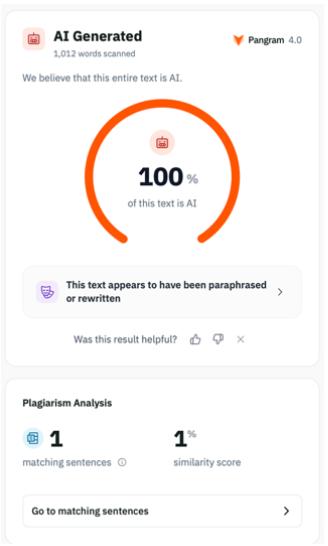
I ran this post through an AI detector before publishing it. It came back 100% AI generated, which is an indictment of either my prose or the detector (and if you know me, this post reads as me). This post started as an email that I wrote in a fit, polished with Claude, and then sent to our senior leadership team early one morning. I then worked with Claude to turn my email into a blog post, and cut the length of the draft by a third. This is the whole point. The tool sits upstream of the work and the judgment is mine, and no detector can tell you which is which. Neither, increasingly, can you, reader. Which is why the standard has to be self-imposed.