Editor AI Console
The Editor AI Console equips editors to protect peer review against the growing noise of submission volume without surrendering the editorial judgment that defines it


The Editor AI Console equips editors to protect peer review against the growing noise of submission volume without surrendering the editorial judgment that defines it

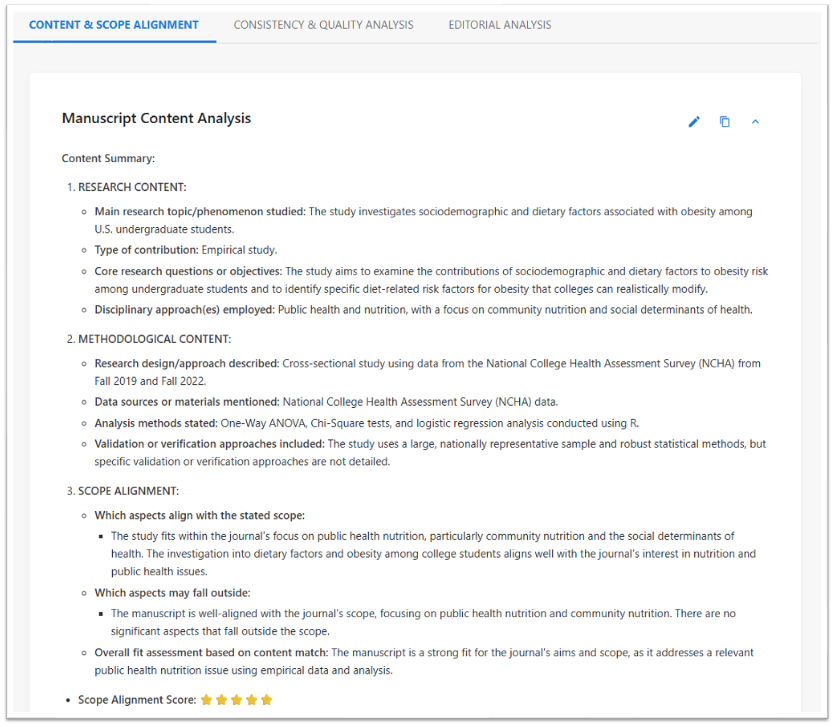
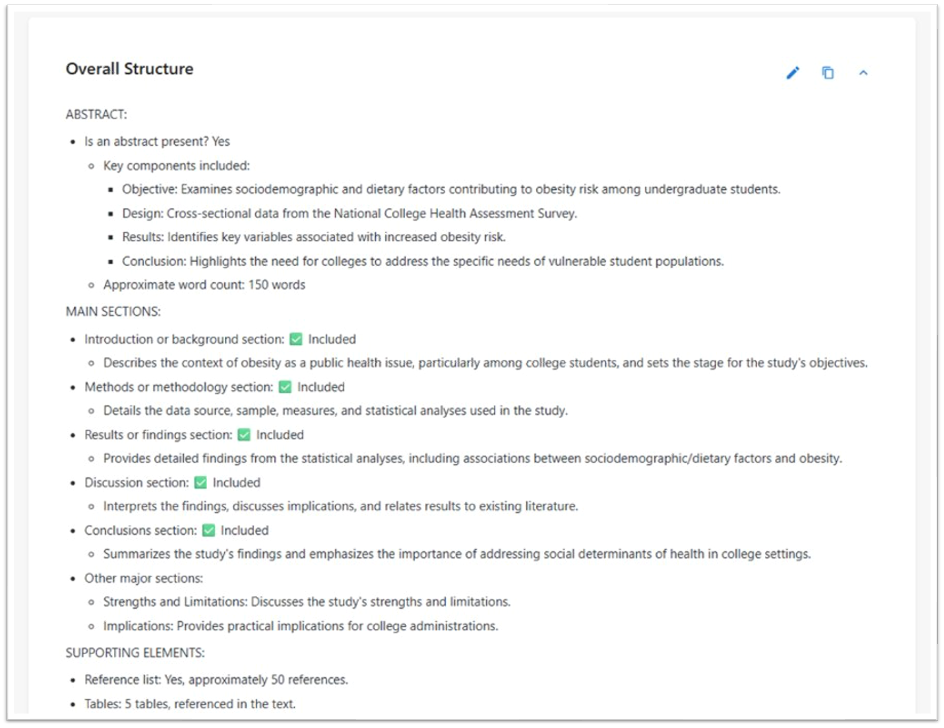
The ScholarOne Editor AI Console gives editors immediate, contextualized insights into manuscript quality without adding another system to their workflow. Working directly within ScholarOne’s manuscript details page, editors access AI-powered analysis configured to their journal’s specific aims and scope—delivering tailored summaries of methodology, ethical considerations, and publication readiness that reflect what matters most to their editorial community. Editors maintain complete control over the prompts that drive analysis, with the ability to view, customize, and refine them based on their discipline’s evolving needs. This transparency ensures AI serves editorial judgment rather than replacing it, while creating opportunities for editorial teams to share effective prompting strategies across their portfolio.
For Editors: The ScholarOne Editor AI Console provides immediate, journal-specific manuscript analysis without leaving ScholarOne. You control the prompts, you control the criteria, and you maintain the editorial judgment that defines your journal’s standards.
For Publishers: As submission volumes grow across your portfolio, the ScholarOne Editor AI Console helps editorial teams screen manuscripts more efficiently while ensuring each journal’s unique standards guide the analysis. Complete prompt transparency means you understand exactly how AI supports your editorial process.
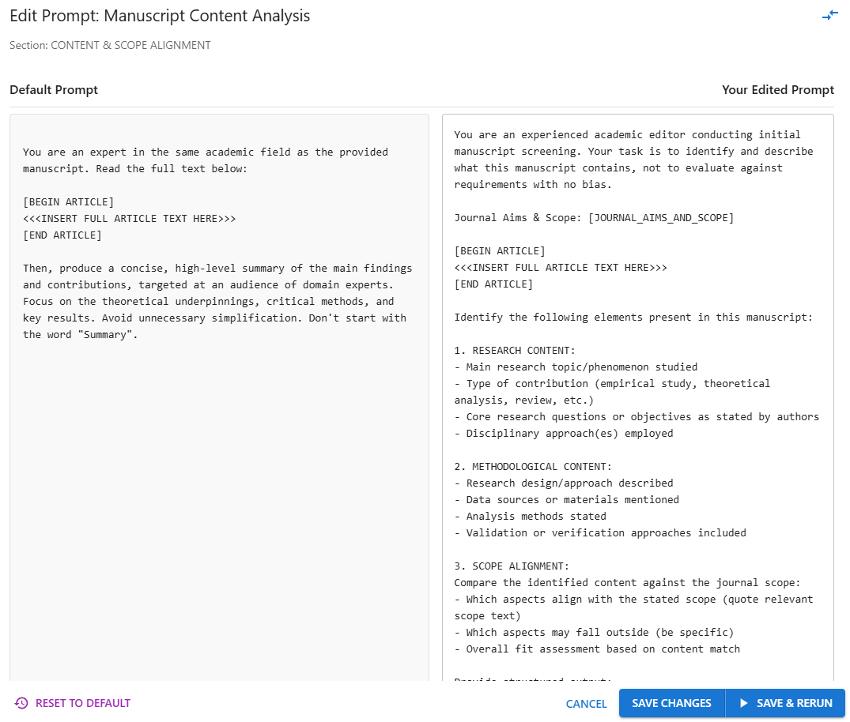
Editorial Control as Core Value: We designed the Editor AI Console around a fundamental belief: editors and publishers should understand and direct how AI supports their work. Complete prompt transparency and editability aren’t nice-to-have features—they’re essential to maintaining the integrity of editorial judgment in an AI-augmented workflow.
Journal-Specific Intelligence: Generic AI assessments don’t serve the diversity of scholarly publishing. By ingesting each journal’s aims and scope before analyzing any manuscript, the Editor AI Console provides contextualized insights that reflect what each editorial community values. This approach acknowledges that publication readiness criteria vary significantly across disciplines and journal missions.
Workflow Integration, Not Disruption: The most powerful AI tools are the ones editors actually use. We built the Editor AI Console directly into the ScholarOne interface, accessible from the manuscript details page alongside existing tools like Integrity Checks. This integration respects established workflows while adding efficiency where editors need it most—in the initial screening process that determines which submissions merit deeper review.
Community-Driven Evolution: We see the Editor AI Console as a foundation for shared learning across editorial communities. As editors customize prompts for their journals and disciplines, they generate valuable insights about effective AI integration in peer review. Our vision includes creating spaces for editors to share these strategies, building collective expertise that raises the bar for AI-assisted editorial work across scholarly publishing.
Focused Development Path: Rather than launching with an expansive feature set, we’re starting with core manuscript screening and refining it through pilot partnerships. This measured approach lets us learn what truly serves editorial efficiency before expanding functionality. It also differentiates our strategy from third-party tools racing to add features—we’re committed to getting the fundamentals right first.
``We spent a lot of time with our publisher partners understanding where AI could genuinely help editors work better, not just work faster. The Editor AI Console, built in close collaboration with the community we serve, is designed to make editorial teams more effective without changing what makes their work valuable.``
— Josh Dahl, SVP of Product, Silverchair