

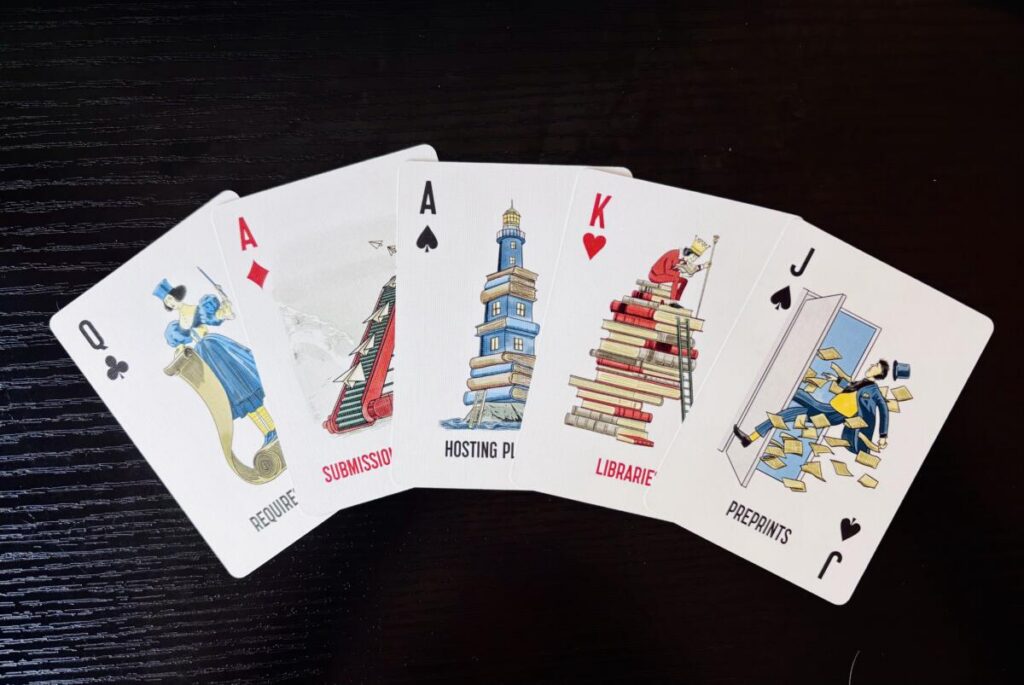
That brings me to Silverchair's marquee swag item of Platform Strategies and our Forum Connect client meetings: a scholarly publishing themed deck of playing cards.
Why playing cards
I will try to avoid as many puns as possible in the telling of the tale. I'm not holding my breath.We usually start swag discussions by yes-anding our way into big, crazy ideas, then walking ourselves back to what our swag provider actually sells. This year, we wanted something interactive. We started thinking about branded chess boards, a perfect play on words for Strategies. But cards have more versatility, and they gave us big opportunities for creativity.
Plus, on a personal level, I love cards. In my household, poker is lovingly referred to as "give the money back to the Bozzones" (my mother's side of the family), and I spent countless rainy afternoons camping in tents and playing cards.
A customized deck of playing cards gives Strategies attendees a few things: a very packable and small thing to take home, something to use that is beautifully illustrated by a real life human being, and a reminder that creativity and humor continue to be the things that connect all of us as an industry.
How playing cards
Once we landed on cards, the real design work started with a question: what do the suits mean?We brainstormed a few ways to split up the suits: different stakeholders, different eras of publishing. We didn't want to stack the deck with something too on-the-nose, so we let the lifecycle shuffle itself into place: submit, review, publish, discover. It gave the deck a structure that scholarly publishing people would recognize immediately, and it gave us four suits with real personality.
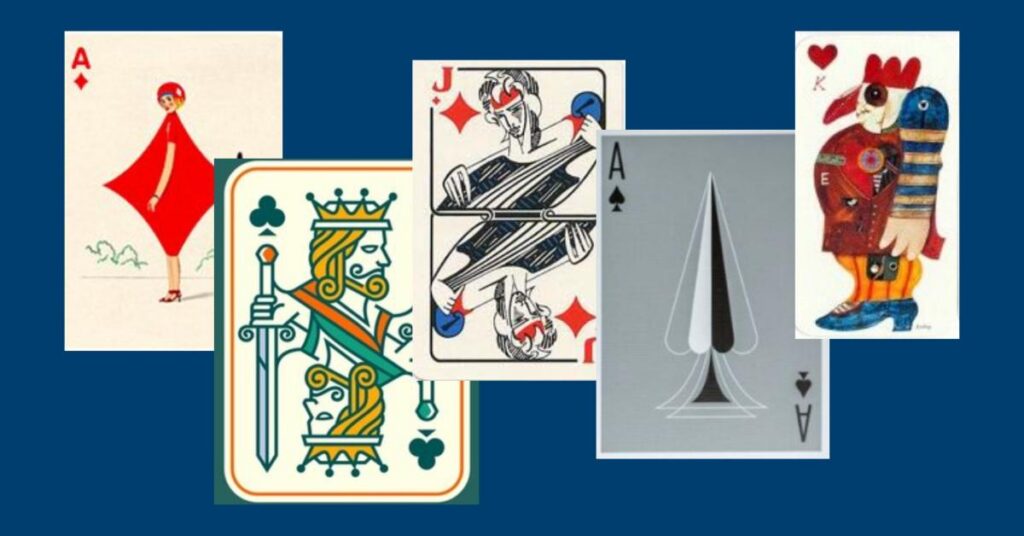
From there, we worked with a designer to bring our vision to life: retro, timeless, a little whimsical. Pinterest boards did a lot of heavy lifting here, letting us point at images instead of trying to describe a feeling in words. He took that mood board and ran with it, and turns out, good design really was in the cards.
Which playing cards
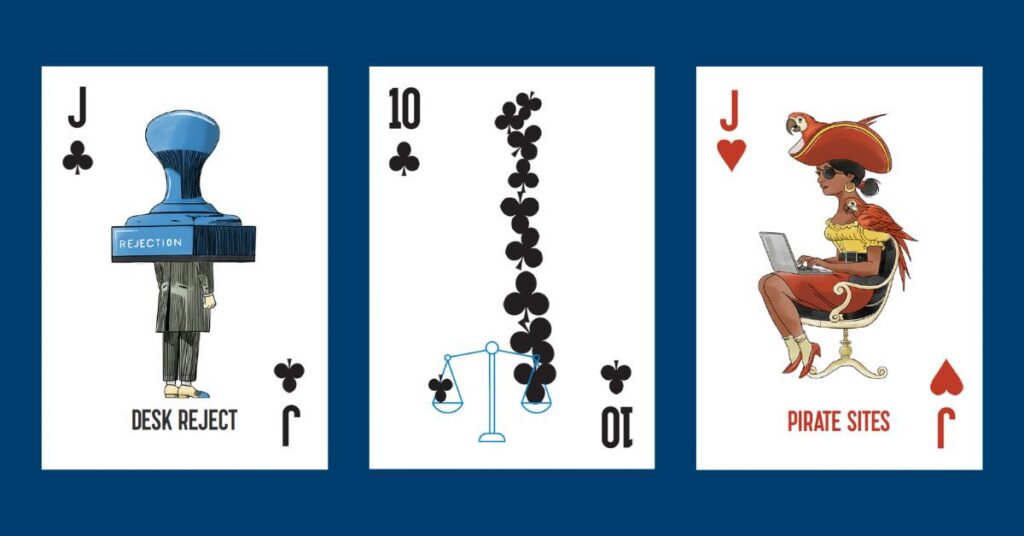
With fifty-two options to pick from, we thought we’d have each member of Silverchair’s Marketing team share their favorite.- Samantha Green, Senior Director of Product Marketing: It was one of the first designs we saw, but the Jack of Clubs, AKA desk reject, is still my favorite. It captures the whimsy I imagined for this deck.
- Stephanie Lovegrove Hansen, VP of Marketing: The face cards are amazing but they always get all the fun - I love that the number cards also get special treatment and the ten of clubs is particularly fun
- Evan Knaus, Digital Marketing Associate: Mine is the Pirate Sites, mainly because it makes me laugh thinking about a pirate surfing the internet - and it looks cool.
The games
A deck of cards is only as good as what you can do with it, so we didn't stop at illustration. We built two original games, each one pulling directly from the publishing themes baked into the suits. Under Review: A Rummy Game of Scholarly Publishing
Every academic knows the feeling of watching a paper fall apart. Now you can lose one on purpose. Play as rummy. Collect "papers," runs of 3+ sequential cards in the same suit, or 3–4 of a kind, and lay them face-up when complete.
- Jack of Clubs = Desk Reject. Play it on your turn to destroy an opponent's paper. Nothing stings like getting desk rejected before the ink even dries.
- Aces = Rebuttal Letters. If your paper gets rejected and you're holding an Ace, play it to appeal, call it revise and resubmit, deck edition. Costs you your next turn.
- Turn: Draw one card (deck or discard), then lay papers, play a Desk Reject, or Appeal, then discard one card.
- Scoring: Play until the deck is empty or a player's whole hand is collected into papers. +1 per card in papers, –1 per card left in hand.
Every trick you take is a little like a citation: it only counts if someone else recognizes it. Play with all 52 cards plus both Jokers. Hearts is scored specially all game but isn't trump, and no suit outranks another.
- Bid: Before each round, bid how many tricks you expect to win. Bid too high and you'll learn what overreach feels like outside of a grant application.
- Turn: One player leads a card, others follow suit if able. Highest card of the led suit wins the trick.
- Jokers auto-win the trick. Funding: you keep it. The Algorithm: you have to give it to another player, proof that even in a card game, the algorithm decides who gets the credit. If both land in the same trick, Funding wins.
- Scoring, each round: 1 point for most tricks (tie = no one scores), 1 point for most hearts, 1 point per Ace collected, +2 if your bid was exact.
- Win: First to 10 points across rounds.
Deal me in
A good piece of swag does more than sit on a desk. It gets picked up, played with, and talked about. We hope Strategies attendees love them, and identify with at least one of the Jacks, Queens, or Kings. The house always wins. This year, so does everyone else.
PS: to see what we come up with next, make sure you sign up to our newsletter so you’re first in line for registering for Platform Strategies next year.